
Evesham Previous Residents by Era
Previous residents are found through an address trail, not one complete list. Begin with the source closest to the time period at issue, keep a notebook of the exact printed address and parcel description, and note whether the person was recorded as a buyer, seller, household member, or notice subject. The source table below distinguishes record coverage from proof of actual presence at an address.
| Source | Period it covers | Where to use it | What it can show |
|---|---|---|---|
| Burlington County PRESS | 1965 forward by owner name; block and lot plus owner from March 1, 2012. | Burlington County Clerk's PRESS portal. | Recorded deeds, mortgages, liens, parties, and legal descriptions. |
| County archive viewer | Before 1965; exact book run is not stated on the landing page. | County's separate historical image archive. | Owner-name indexed property images. |
| State Archives county deeds | County deed books beginning in 1785; microfilm through 1900. | New Jersey State Archives and FamilySearch digitization. | Grantor, grantee, consideration, witnesses, and land descriptions. |
| County and city directory titles | Selected 1876–77, 1895, 1899–1911, 1913, 1926, 1929, 1945, and 1955–56 titles. | State Library, NJHS, BCLS, and Library of Congress leads. | Address or household entries only where the volume covers the locality. |
| Federal census | 1790–1950 released under the 72-year rule. | NARA and BCLS research databases. | Household members and later address context. |
| BCLS newspaper notices | Citations from 1810 forward, with uneven newspaper coverage. | Online index and New Jersey Room. | Deaths, burials, births, marriages, family links, and local events. |
The other useful channels are Evesham Construction for an identified permit or inspection file, the Burlington County Surrogate for probate, and the State Archives for archival county records. Online reach varies by series. A specific counter, mail, archive, or OPRA request is the reliable fallback when an index does not show the needed item.
Note: Use the source that fits the date, then keep its access route with the address notebook when an older Evesham record needs follow-up.
Start an Evesham Address With Its Parcel
For previous residents, the current parcel is the bridge back. Use the Evesham WIPP property portal or the municipal assessor to locate the current assessment record. Preserve the situs address, block, lot, qualifier, parcel identifier, current owner or taxpayer, mailing address, and tax year. A situs address identifies the land's physical location. A mailing address tells the tax office where it sends correspondence. They are not interchangeable.
Evesham's municipal code is 0313. County parcel metadata uses the code with block, lot, and an optional qualifier. That combination is more durable than a modern street number when a prior deed identifies a tract, subdivision, or metes-and-bounds description. The statewide parcel service can help locate a standard PIN, but it warns that parcel polygons are not legal surveys and redacts some names under Daniel's Law.
Use a simple address notebook: exact source wording, modern address, block and lot, legal description, date, person or entity role, source link or citation, and confidence note. It makes a later correction possible when a name is similar or the street form changes.
Walk Back Evesham Deed Transfers
The Burlington County deed chain is a grantor-grantee trail. A grantor is the party transferring property. A grantee is the party receiving it. Start with the current owner or parcel record, find that person's purchase as a grantee, and use the seller shown on the deed to locate the next earlier purchase. Match block, lot, subdivision, or legal description at every step. A chain of title is that linked sequence of transfers for the same land.
- Find the current Evesham parcel in WIPP or through the assessor, and write down its legal block and lot details.
- Search the current owner in Burlington County PRESS as a grantee, then narrow the result with the parcel description and likely date.
- Record the instrument number, recording date, book and page if shown, parties, municipality, and legal description from the matching deed.
- Use the deed's grantor as the next grantee search, then repeat only after the same parcel identity is confirmed.
- When the period passes the online search boundary, use the county archive, public computers, State Archives material, or a specific copy request.
- Grantor / grantee
- The party giving property and the party receiving it in a recorded transfer.
- Chain of title
- The ordered history of recorded transfers attached to one parcel or legal description.
- Legal description
- The land identity written in a deed, often using lots, blocks, tract language, or measured boundaries rather than a postal address.
A deed may name an estate, trustee, corporation, spouse, or representative. That detail can help separate same-name people, but it is not a substitute for matching the land description. A later sale date also does not establish when a household left or arrived.
Note: Preserve both the deed's recorded date and the source's displayed description, because a parcel can retain its identity while its street label changes.
Read PRESS Limits for Evesham Previous Residents
PRESS has a useful but uneven historical split. It permits block and lot plus owner-name searches for property records recorded on or after March 1, 2012. The 1965 through February 2012 portion is owner-name searchable. The pre-1965 portion belongs in the separate county image archive, where owner-name searching and guest login are available. The result is a practical research quirk: a modern address must often be translated into an owner name before the older trail can begin.
The county reports that more than 1.7 million documents may be immediately called up in its system. Public searches can display watermarked images; expanded public registration provides no-watermark access. Some records still require the clerk's public computers or a document-specific copy request. Maps recorded before 1995 are not available through PRESS, so match an older plan through tax maps, plats, or the appropriate archive channel.
The PRESS deed-index page captured for previous-resident research shows the search modes used to move from a parcel key or name to a recorded transfer.
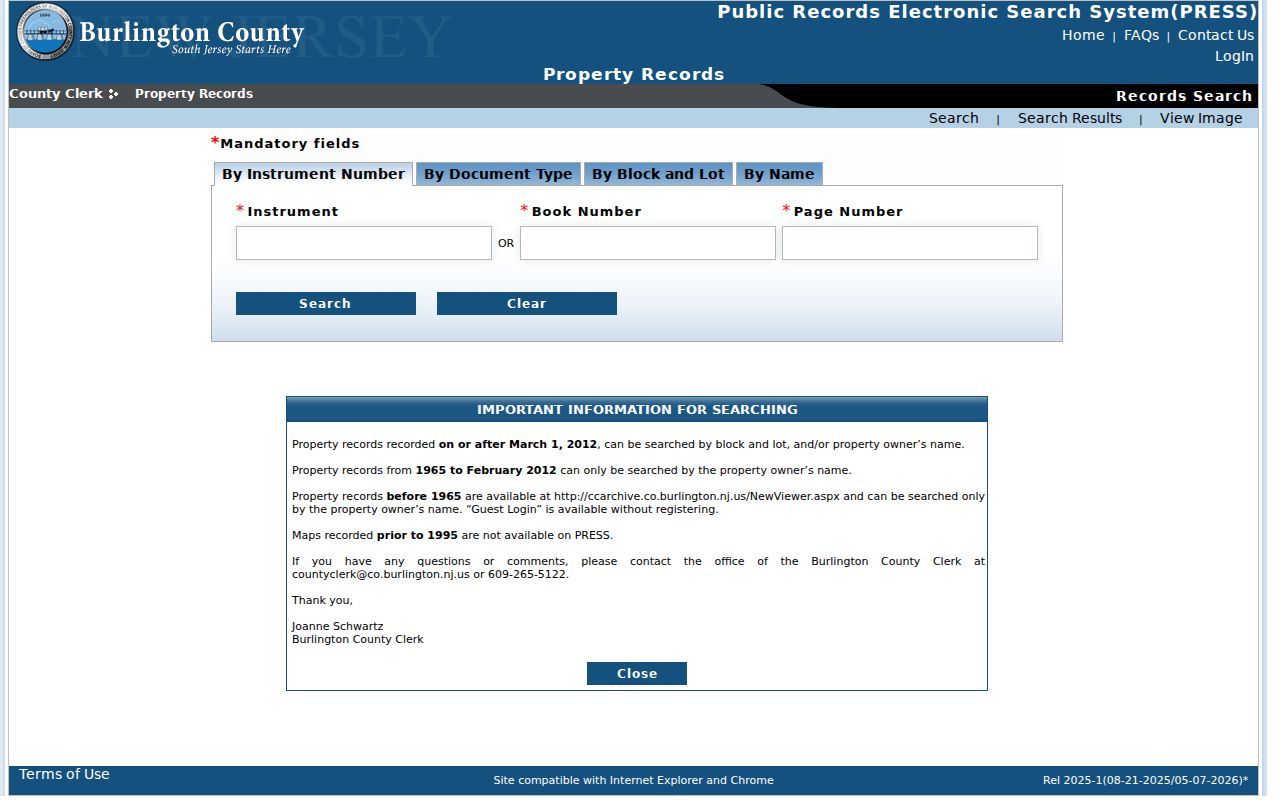
Use the index to locate and verify a specific instrument, then continue backward through matching grantor and grantee entries rather than relying on a broad address match.
Extend Evesham Deed History at Archives
When the county's online path stops, earlier Evesham previous residents research moves to the New Jersey State Archives, county deed microfilm, and FamilySearch catalog material. State Archives says county deed books begin in 1785 or the year a county was created, that county deeds were microfilmed through 1900, and that indexes continue later. Burlington catalog records include deeds from 1785–1901, deed indexes from 1785–1948, mortgages from 1776–1861, and road records from 1762–1950.
This long record reach is an Evesham history advantage. Burlington County's deed-recording practice reaches back to colonial West Jersey and the 1799 act requiring acknowledged deeds to be recorded in county books. It is also why a serious house history should keep the modern PRESS result, the pre-1965 archive search, and the archival deed source in the same chain.
Mortgage records can reveal another party's relation to the land, but they are not a replacement for a deed. For a missing street label, use road records, plats, and the legal description to reconcile the location. State Archives is the formal records fallback; BCLS and local historical sources can supply context around it.
Pair Evesham Previous Residents With Households
Deeds identify a property trail, while printed directories and the federal census can add a household layer. The catalog evidence for Evesham is regional and uneven. A directory title may cover Burlington County, a larger town, or rural routes without offering continuous Evesham coverage. Search a surname and address in the same volume, check its abbreviation key, then compare the result with the nearest census year. The dedicated volumes and access cautions are detailed in the Evesham city directory collections.
Use this order for a historical address: parcel and deed description, nearest usable directory, nearest released census, then a newspaper or probate clue. Federal census dates, directory publication timing, and moves can differ. The 1890 census cannot supply its usual household checkpoint because most of that federal census was destroyed in 1921.
For Evesham, search Evesham, Marlton, Evesboro, Marlton village, rural-road names, and spelling variants. A directory might use the familiar postal place while the deed retains the township. An address section or criss-cross section is helpful only if that exact volume contains it and the locality is actually included.
Use Evesham Notices and Probate Endpoints
The BCLS Newspaper Notices Index is a strong endpoint source for former Evesham households. It includes more than 350,000 citations and lets a researcher use surname, first name, category, sort choices, and month or year limits. Death, burial, birth, and marriage categories can connect a person to family members or a later location. It is a finding aid, not a complete newspaper run or a vital certificate.
The index began as 3x5 death, marriage, and birth cards transcribed by volunteers from 1999 to 2002. It keeps original misspellings and some date errors. A month and year may display as the first day of the month, and duplicate citations can be separate newspaper notices. Search the surrounding newspaper issue before treating a citation as a final answer. BCLS's New Jersey Room, with almost 10,000 microfilmed newspaper reels at its Westampton headquarters, is the deeper local channel.
After a death or estate clue, ask the Burlington County Surrogate or the State Archives for the appropriate probate record. The Burlington probate guide covers 1878–1904, while county surrogate microfilm is mostly available through 1900. An executor, heir, estate parcel, or sale can explain the transition from one recorded owner to another.
Note: A newspaper notice can direct a search, but the deed, probate file, or official vital record remains the stronger source for the legal event.
Bridge Evesham and Marlton House History
Previous residents can be missed when the search uses only one place name. Marlton is the post-office and common village name, but Evesham Township is the legal municipal name. The village, post office, and Baptist church adopted the Marlton name in 1845 after the local marl-mining identity took hold. A nineteenth-century record may therefore use Evesham, Marlton, or a rural route for the same property area.
Check tax maps, plats, legal descriptions, historical road records, and the printed source wording before deciding a record belongs elsewhere. The county's uniform emergency-address system is valuable for the modern physical reference, but an old deed can omit that number entirely. A legal description is usually the firmer bridge across the name change.
Respect Limits on Evesham Previous Residents
Past ownership and past presence are different facts. A former owner may have used another mailing address. A directory result may omit an address, and a census record may not line up with a deed date. Some addresses and names are properly shielded by Daniel's Law or the New Jersey Address Confidentiality Program. Utility and delivery records are not a substitute for the public house-history trail.
New Jersey's Open Public Records Act, P.L. 2001, c.404, N.J.S.A. 47:1A-1 et seq., can support a request for an identifiable public record. It does not require a custodian to compile a custom house list or resolve an identity question. State the address, block and lot, record type, and date range when using an OPRA route.